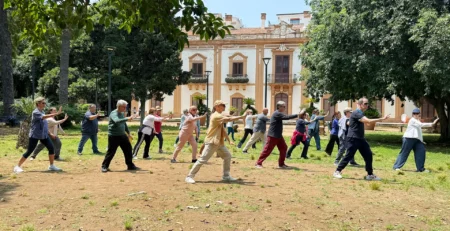
Watch a group practicing tai chi slowly in a park and it is reasonable to think you are seeing gentle exercise or meditation. Ask a martial arts teacher and you may hear about balance, contact, timing, and responding to another person. Are they describing different activities?
Sometimes they are describing different ways of teaching. They can also be describing different parts of Tai Chi Chuan, a practice whose slow solo form is only one visible expression.
Why the martial art question matters
The full name Tai Chi Chuan, or Taijiquan, refers to a martial art. Its movements have a relationship with receiving, redirecting, and issuing force. That does not mean your first lesson should involve fighting, or that every class must teach self-defense. Many schools focus on accessible solo practice, and people may choose tai chi for a wide range of reasons.
The martial context does, however, help explain why posture, weight distribution, timing, and coordinated movement matter. Without any sense of purpose, a movement can become an attractive gesture. With a sense of direction, you can begin to ask how your body is organized and whether it could respond to change.
Why people call it moving meditation
In a form, you may move slowly enough to notice habits you normally miss: holding your breath during a turn, tightening your jaw when you concentrate, or stepping before your weight is ready. Paying attention to these details can make practice feel meditative.
But “moving meditation” is a description of one quality of the experience, not a complete explanation of the art. Attention has a job to do. It helps you sense where you are supported, how one action leads into another, and whether you have added effort you do not need.
Does slow movement have a purpose?
Slow practice gives you time to observe and refine. It can reveal a loss of balance that speed would hide. It can help you distinguish a deliberate weight shift from a quick lean. Slow does not mean passive, and it does not mean that all Tai Chi Chuan practice is performed at the same speed.
Nor does speed alone tell you whether a movement is useful. A fast movement built on poor coordination is still poorly coordinated. Slow practice is valuable when it teaches you something you can carry into more demanding situations.
What about health and well-being?
Many people begin tai chi because they want a sustainable movement practice or simply enjoy how it feels. Those are valid reasons to attend a class. You do not have to pursue martial applications to benefit from learning to move with more awareness.
It helps, though, to recognize which part of the art your class emphasizes. If you are interested in partner work or the martial logic of the movements, ask whether the teacher covers those areas. If you prefer a gentle introduction, look for a class taught at an appropriate level. Neither preference needs to be hidden behind a single definition of tai chi.
A fuller answer
Tai Chi Chuan is a martial art that can be practiced as attentive movement and may be taught with an emphasis on well-being. These dimensions need not cancel each other out. Understanding the relationship among them keeps the practice from becoming a vague label for “moving slowly.”
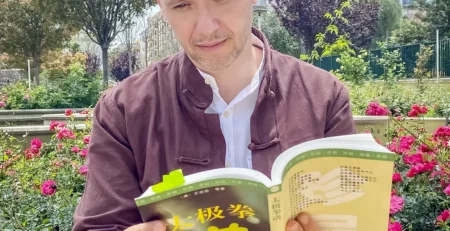
In Beginning Tai Chi Chuan: An Essential Guide, I start with precisely this question and continue into structure, release, coordination, intention, and the classical ideas that inform practice. The aim is to help you recognize what you are learning, whatever first brought you to tai chi.