The best tai chi book depends on what you want it to help you do. A visual guide may be useful when you are learning a particular sequence. A book on principles can help when the sequence makes sense but the movements still feel empty. A reader interested in health research or accessible practice needs something different again.
I teach Tai Chi Chuan and have written one of the books below, so this is an author’s selection, not an independent ranking. I have included it where I believe it fits and pointed to other books when they serve a different purpose better. Book descriptions and formats can change; check the linked publisher or book pages for current details.
At a glance
| If you want to… | Start with… |
|---|---|
| Understand the foundations behind a form | Beginning Tai Chi Chuan, Valerio Bellone |
| Explore tai chi through health research and a practical program | The Harvard Medical School Guide to Tai Chi, Peter M. Wayne and Mark L. Fuerst |
| Read traditional writings with commentary | The Essence of T’ai Chi, Waysun Liao |
| Explore illustrated practice adapted to different mobility levels | Adaptive Tai Chi, Zibin Guo |
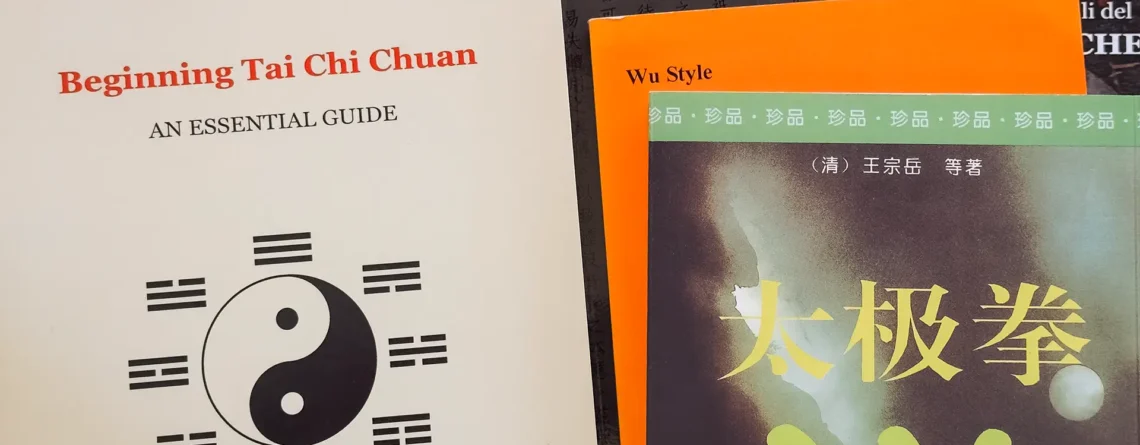
For understanding what you are practicing: Beginning Tai Chi Chuan: An Essential Guide
My book is for someone beginning Tai Chi Chuan who wants a clear explanation of the art’s foundations, and for an existing student who can follow a form but still has questions about balance, structure, release, and intention. It also introduces thirteen selected passages from the classical tradition with commentary that brings their ideas back to practice.
Choose it if: you want the principles behind the movements explained in approachable language, without extraordinary promises.
Choose another kind of guide if: your immediate goal is to learn the exact order of a form from photographs. This book does not present a pose-by-pose visual course.
See the contents and intended readers of Beginning Tai Chi Chuan.
For a health-centered introduction: The Harvard Medical School Guide to Tai Chi
Peter M. Wayne and Mark L. Fuerst connect tai chi practice with health research and offer a practical program. If you come to tai chi because you want to understand how it is discussed in the context of health and daily life, this is a good direction to explore.
Choose it if: a research-informed, health-oriented introduction is your main interest.
Consider pairing it with: instruction that helps you adapt the movements to your circumstances and a principles-focused guide if you want a deeper discussion of the art’s traditional language.
Read the publisher’s description.
For a first encounter with classical texts: The Essence of T’ai Chi
Waysun Liao presents translations and commentary on core tai chi writings. The book is a compact way to encounter the vocabulary and ideas that have shaped how generations of practitioners discuss the art.
Choose it if: you are curious about classical principles and enjoy reading traditional texts alongside commentary.
Keep in mind: even clear commentary may take time to connect with your own movements. A passage often becomes more useful after you have had a concrete experience to compare it with.
Read the publisher’s description.
For adaptable illustrated sequences: Adaptive Tai Chi
Zibin Guo presents illustrated practices modified for different physical abilities, including seated and wheelchair sequences as well as standing options. This is a more specific answer to a common problem: an instruction designed around one kind of standing body may not meet every reader where they are.
Choose it if: you are looking for visual guidance that acknowledges different mobility needs.
Keep in mind: illustrations still cannot offer individual feedback. If you are adapting practice around a condition or limitation, work with instruction suited to your needs.
Read the publisher’s description.
Which tai chi book should you buy first?
Ask what is missing from your practice right now. If you want an illustrated movement sequence, select a book or course that teaches the same approach as your instructor. If you want a health-oriented overview, consider Wayne and Fuerst. If traditional writing interests you, Liao offers a direct entry point. If you need adapted illustrated practice, Guo deserves a close look.
If your main frustration is that you can imitate the movement but do not yet understand its logic, my guide was written for exactly that question. It is also a useful way to decide whether a more specialized book should come next.