You can learn a great deal about tai chi from a book. You can also use one to deepen what you are already practicing. But if by “learn tai chi” you mean developing the physical skill of moving with balance, coordination, and sensitivity, reading alone has limits.
This is not a reason to avoid books. It is a reason to use them well.
What a book can do particularly well
A good book can give you language for sensations that are hard to name. What does “relax” mean when you still need to stand? What is the difference between shifting weight and merely leaning? Why might a movement be described as both soft and structurally connected?
These questions often get compressed into brief instructions during class. Reading lets you pause, compare explanations, and return to an idea after you have experienced it in practice. Books can also introduce the history and classical writings of Taijiquan without requiring a teacher to turn every lesson into a lecture.
For a beginner, that context can reduce confusion. For someone who has practiced for years, it can reveal a familiar instruction in a new light.
What a book cannot see
A page cannot tell whether you have locked a knee, shifted your weight before taking a step, or mistaken tension for stability. Even an excellent illustrated manual cannot answer the question, “What am I doing right now?”
That is where an instructor or an attentive practice partner helps. Feedback is not merely about correcting the shape of a posture. It can help you recognize the difference between what you intended to do and what actually happened.
Video offers a better view of movement than a still page, but it has the same basic limit when no one sees you in return. Neither a book nor a recording can promise that copying a demonstration will reproduce the skill behind it.
How to use a tai chi book alongside practice
Choose one idea that you can investigate without forcing an unfamiliar movement. You might read about weight distribution, then notice in class when one foot becomes free to step. Or you might read about releasing unnecessary effort and observe whether your shoulders rise whenever you concentrate.
Take that observation back to your teacher: “I notice my shoulders tighten during this turn. What should I look for?” A specific question joins reading to experience. Trying to apply ten new instructions at once usually makes both less useful.
If you have no access to a class, a book can still help you understand the territory and decide what kind of teacher or course you want. Keep your physical practice modest, and be cautious about treating descriptions of complex movements as personal correction.
Choose the book for the job you need done
Some tai chi books emphasize photographs and the order of a form. Others focus on health research, martial applications, classical texts, or underlying principles. There is no single volume that does all of these equally well.
If your main question is “Where should my hands go next?”, you may want visual instruction tied to the form you are learning. If your question is “What makes this movement tai chi rather than choreography?”, a book on principles is the better companion.
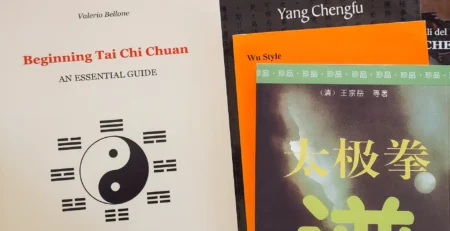
That second question shaped my book, Beginning Tai Chi Chuan: An Essential Guide. It explains the foundations of practice, common misunderstandings, and thirteen selected classical passages. It is meant to help you think and practice more clearly, especially alongside direct instruction; it is not a picture-by-picture substitute for a teacher.