Most people who practice Tai Chi eventually want to read about it, and that is when the search for the best Tai Chi books begins. Sometimes the aim is to make sense of the movements. More often, however, it is to get closer to what stands behind them: the worldview, the philosophy, and the internal principles that Tai Chi Chuan (Taijiquan) is built on.
Tai Chi began as an internal martial art, although today most people practice it for health, balance, and longevity. Those are good reasons to practice. But treating it as slow exercise and nothing more leaves out most of the system: its roots in classical Chinese culture, in Daoist (Taoist) thought, and in a refined understanding of the human body.
Finding Tai Chi books is easy, since there are hundreds in English, from classical texts only a few lines long to modern manuals written for Western readers. Choosing among them is harder, because only a small share of what is in print will change how you practice.
For that reason, what follows is a selected reading list and not a complete one. It is organized by level and by purpose, and every title is available in English on Amazon.com. Four of the books are my own, so I have marked them clearly and said what each one is for. The rest are books by other authors that I think are worth your time. No book can replace practice, but the right one can change the way you practice.
What are the best Tai Chi books for beginners?
These are introductions and general works, so you can read any of them with no background at all.
By Valerio Bellone · Start here
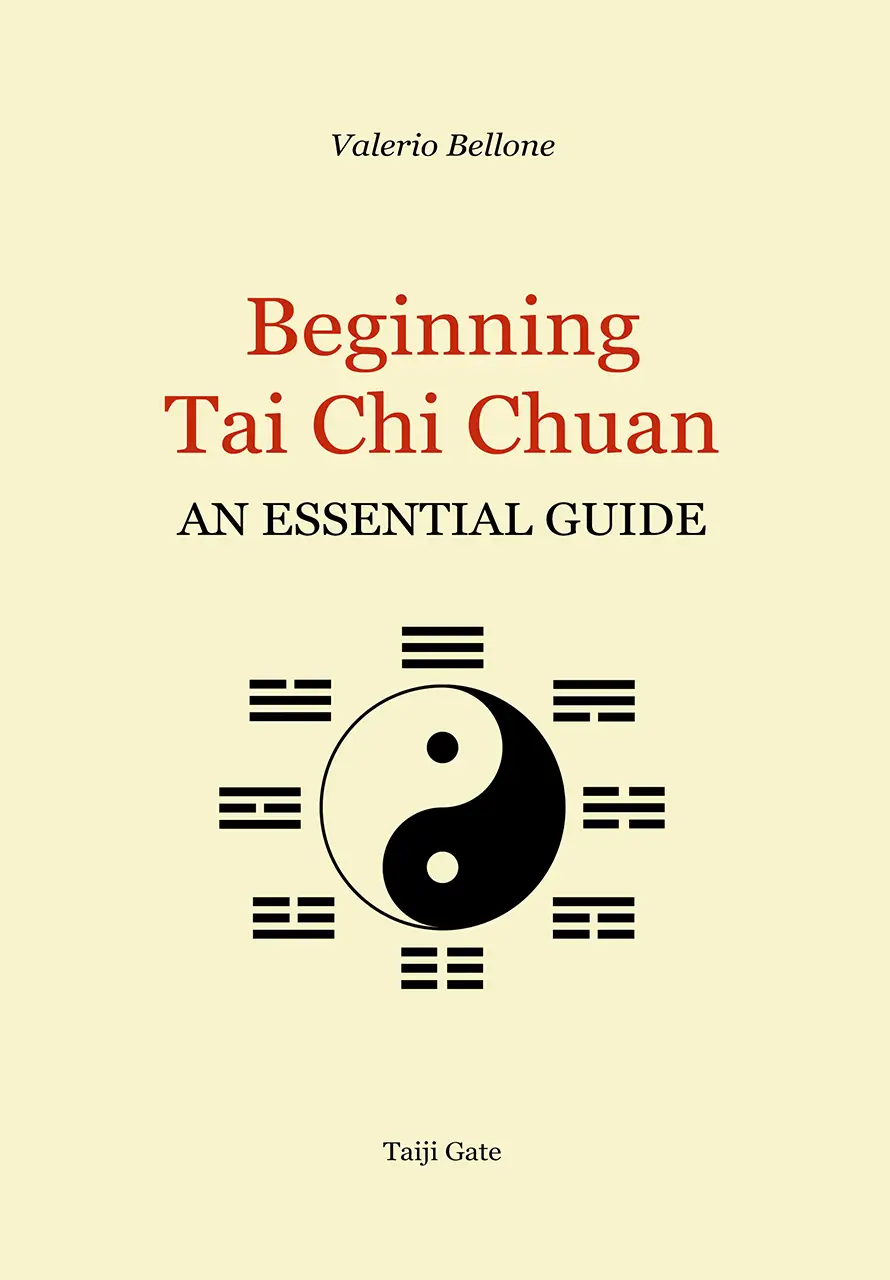
Beginning Tai Chi Chuan: An Essential Guide
I wrote this book for readers who want to understand what they are practicing rather than just copy a sequence of movements. It is not a step-by-step manual for memorizing a form. Instead, it explains what makes Tai Chi Tai Chi: structure, release, balance, intention, and the relationship between full and empty. It also explains what “internal” means, in plain terms and without mystification.
You will find the mistakes most beginners make, as well as a sensible way to approach practice and criteria for recognizing sound teaching. The last part introduces thirteen passages from the classical texts, each explained in relation to practice, followed by a glossary of the essential Chinese terms.
It promises neither quick results nor secret formulas. Read it if you are new and want to start well, or if you have been following along in class for a while and still have more questions than answers.
Classic introductions from Chinese masters
Cheng Tzu’s Thirteen Treatises on T’ai Chi Ch’uan, by Cheng Man-ch’ing, translated by Benjamin Pang Jeng Lo and Martin Inn
Cheng Man-ch’ing was a painter, poet, calligrapher, and physician, and one of the best-known Taijiquan teachers in the West, where his short form is still widely practiced. He was also a direct student of Yang Chengfu, the central figure in the spread of modern Taijiquan. His thirteen essays read simply and are anything but shallow. They move through anatomy, energy, philosophy, healing, and martial application.
T’ai Chi Ch’uan and Meditation, by Da Liu
In the West, Tai Chi is usually seen either as a martial art or as health exercise. Da Liu, one of the first teachers to bring it to the United States, presents an older view instead: a discipline practiced alongside meditation, aimed at harmony with nature and at the development of the whole person. His book helps explain why Taijiquan cannot be separated from the culture that produced it.
A Study of Taijiquan, by Sun Lutang, translated by Tim Cartmell
Sun Lutang was one of the great Chinese martial artists of the early twentieth century: accomplished in Xingyiquan, Baguazhang, and Taijiquan, and the founder of the Sun style. He was among the first masters to publish books on the internal arts. In fact, a number of ideas now treated as standard in Tai Chi can be traced to this one. Tim Cartmell’s translation was its first English edition.
Modern guides and overviews
T’ai Chi Classics, by Waysun Liao
Waysun Liao translates three core classical texts, then surrounds them with his own teaching on ch’i, internal power, and practice. It is a personal reading, shaped by his experience and his approach, so take it as one teacher’s view of the classics and not as a close study of the source texts. Read that way, it is still an interesting book.
The Complete Book of Tai Chi Chuan: A Comprehensive Guide to the Principles and Practice, by Wong Kiew Kit
A broad, well-organized guide, written above all with the newcomer in mind. It surveys the main styles of Taijiquan and introduces the Chinese philosophical ideas the art rests on.
The Harvard Medical School Guide to Tai Chi, by Peter Wayne with Mark Fuerst
Unlike the other books here, this one comes from the medical side. Peter Wayne, a Harvard Medical School researcher and longtime Tai Chi teacher, reviews the medical research on Tai Chi and then lays out a simplified twelve-week program. It is not a traditional text and does not try to be, but if your question is what the evidence says about Tai Chi and health, this is the book that answers it.
Which Tai Chi books go deeper for intermediate and advanced practitioners?
When you have a regular practice, the most useful reading is the classical literature itself: the texts that each generation of practitioners has gone back to. That is the literature my Taijiquan Classics trilogy is devoted to. Its three volumes cover the foundational writings of Wang, Wu and Li as well as the textual traditions of the Chen and Yang families.
By Valerio Bellone · Taijiquan Classics trilogy, Volume I
The Three Taijiquan Classics of Wang, Wu and Li: Translations and Commentaries
The writings attributed to Wang Zongyue, Wu Yuxiang, and Li Yiyu are the theoretical core of Taijiquan. They are not technical manuals in the modern sense, but short, dense texts that set out the internal principles of the art: the relationship between yin and yang, the idea of jin (trained force), and the way body, intention, and movement work together.
This volume gives you the original Chinese and an English translation, together with a commentary that connects each passage to practice, history, and the culture it came from, with nothing filtered out and nothing oversimplified. Because it is not tied to a single style, it serves you whatever lineage you practice: these are the texts your art refers back to.
You do not read these classics once. Instead, you keep them beside you for as long as you practice.

By Valerio Bellone · Taijiquan Classics trilogy, Volume II
Traditional Manuals and Writings on Chen-Style Taijiquan
Chen is the oldest of the Taijiquan styles. This volume takes you through its written tradition, from the fundamentals to the most technical questions, including the internal qualities, jin, chansi (silk-reeling), tui shou (push hands), and the traditional method of study.
Every section is built to make a bridge between the page and the body. In other words, it is not a museum of dead quotations but a working guide to the documents, the traditional vocabulary, and real Chen-style training.

By Valerio Bellone · Taijiquan Classics trilogy, Volume III
Classics and Traditional Writings on Yang-Style Taijiquan
Yang is the most widely practiced style of Taijiquan in the world, but it is also one of the most simplified and most misunderstood. That is why this volume goes back to the sources to show what lies behind the modern image of a practice sold only as gentle exercise.
Working from texts connected with the first generations of the Yang family and the main lines of transmission, it reconstructs a method that is richer, more technical, and more martial than most people assume: structure, rooting, continuity, the distinction between empty and full, listening, transformation, the issuing of force, and the traditional use of weapons.
It is not a historical catalogue but a study tool for understanding where the Yang style comes from and which principles still define the practice today.

Another book for experienced practitioners
The Dao of Taijiquan: Way to Rejuvenation, by Jou Tsung Hwa
For decades this was one of the best-known Tai Chi books in the United States. Jou Tsung Hwa presents Taijiquan in an accessible way without flattening it, and he takes in philosophy and martial practice as well as the therapeutic side. The approach is his own, but the overview is valuable, especially if you want a bridge between Chinese thought and a Western way of thinking. New copies can be hard to find, so you may need to buy it used.
Which Chinese classics help you understand Tai Chi?
Taiji is a concept from classical Chinese philosophy, closely tied to Daoist thought, while Taijiquan is the martial art that applies it to movement. If you want to understand Tai Chi at its roots, these cornerstone texts are hard to do without:
- The I Ching or Book of Changes, in the classic Wilhelm/Baynes translation, is the source of the word taiji itself as well as of the language of yin, yang, and change that the Tai Chi classics draw on.
- Tao Te Ching, by Lao Tzu, translated by D. C. Lau: the foundational Daoist text, in which the soft overcomes the hard and yielding achieves more than force.
- The Complete Works of Zhuangzi, translated by Burton Watson, is above all a book of stories about spontaneity, skill, and acting without forcing.
- The Book of Lieh-tzu: A Classic of the Tao, translated by A. C. Graham: the third of the classic Daoist books, told mostly through parables.
Confucian and Buddhist texts
Over the centuries, Daoism also became intertwined with Confucianism and Buddhism. Both shaped Chinese culture deeply and, indirectly, Taijiquan, so these are good ways in:
- Analects: With Selections from Traditional Commentaries, by Confucius, translated by Edward Slingerland, gives you the sayings of Confucius together with excerpts from the Chinese commentaries that show how the text has been read.
- Confucianism: A Very Short Introduction, by Daniel K. Gardner, is a compact overview of the tradition and its main texts, so it is a good place to begin.
- Finally, The Platform Sutra of the Sixth Patriarch, translated by Philip B. Yampolsky, is a foundational text of Chan (Zen) Buddhism from Tang-dynasty China, attributed to the Sixth Patriarch, Huineng.
How should you use Tai Chi books?
A common mistake is to treat Tai Chi books as instruction manuals. The classics in particular were never written to be understood without guided practice. Historically they belonged to an oral transmission: they served as a reference and a support for study rather than as a substitute for direct teaching.
Read without practice, therefore, they carry two risks. One is intellectualizing ideas that are meant to be experienced in the body, while the other is misreading deep principles and reducing them to abstract formulas.
That is why the classical texts give the most when you study them alongside steady practice and with a competent teacher, someone who can connect the words on the page to what happens in movement. Then reading changes your practice and does more than add to what you know.
Of course, the right book at the right time can open a new view of Taijiquan. But it is practice, over time, that gives full meaning to what the texts say so briefly and, often, in deliberately allusive language.